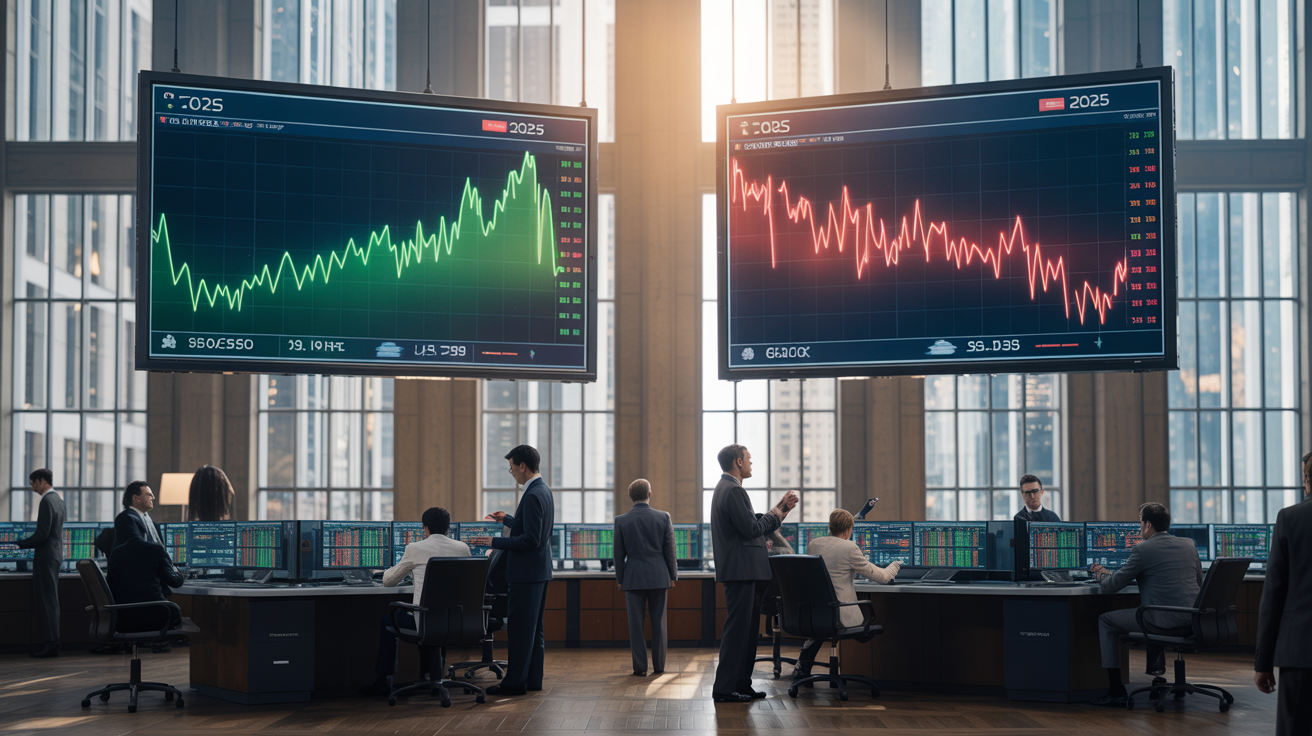
AI's Reality Check: The 2025 Winners, Losers, and What Wall Street Got Wrong
As we close the books on 2025, the AI revolution's scorecard reveals spectacular winners (+156% returns), devastating losers (-33% crashes), and a $6 million Chinese startup that blindsided Wall Street. The year that was supposed to be AI's coronation became a masterclass in market humility.
AI's Reality Check: The 2025 Winners, Losers, and What Wall Street Got Wrong
A year-end reckoning on the AI revolution's first full year of market dominance
As we close the books on 2025, one thing is crystal clear: Wall Street's crystal ball was cloudy at best. The year that was supposed to be AI's coronation turned into a masterclass in market humility, featuring spectacular winners, devastating losers, and surprises that blindsided even the sharpest analysts.
The numbers tell a story of extremes. While the Morningstar Global Next Generation Artificial Intelligence Index surged 46.65% year-to-date through November—crushing the broader market's 15% return—the journey resembled a heart monitor more than a steady climb. Early 2025 saw AI stocks plummet in a panic that erased hundreds of billions in market value. Then came the rebound. Then more volatility. Welcome to the new normal.
The Biggest Surprise: DeepSeek's $6 Million Earthquake
If you'd told Wall Street in January that a Chinese startup would build an AI model for what it claimed was under $6 million—rivaling OpenAI's multi-billion-dollar investments—you'd have been laughed out of the room. Yet DeepSeek did exactly that, triggering the year's most violent market correction.
When DeepSeek's R1 model launched in late January 2025, it didn't just compete with GPT-4—it matched its performance at a fraction of the cost, using older, cheaper Nvidia H800 GPUs instead of cutting-edge H100s. The market's response was swift and brutal:
- Nvidia lost $593 billion in market cap in a single trading session
- Energy stocks like Constellation Energy cratered on fears of lower AI power demands
- The "Magnificent Seven" tech stocks collectively shed over $1 trillion in value
- Chinese tech stocks rallied as investors suddenly saw a viable path to AI dominance outside Silicon Valley
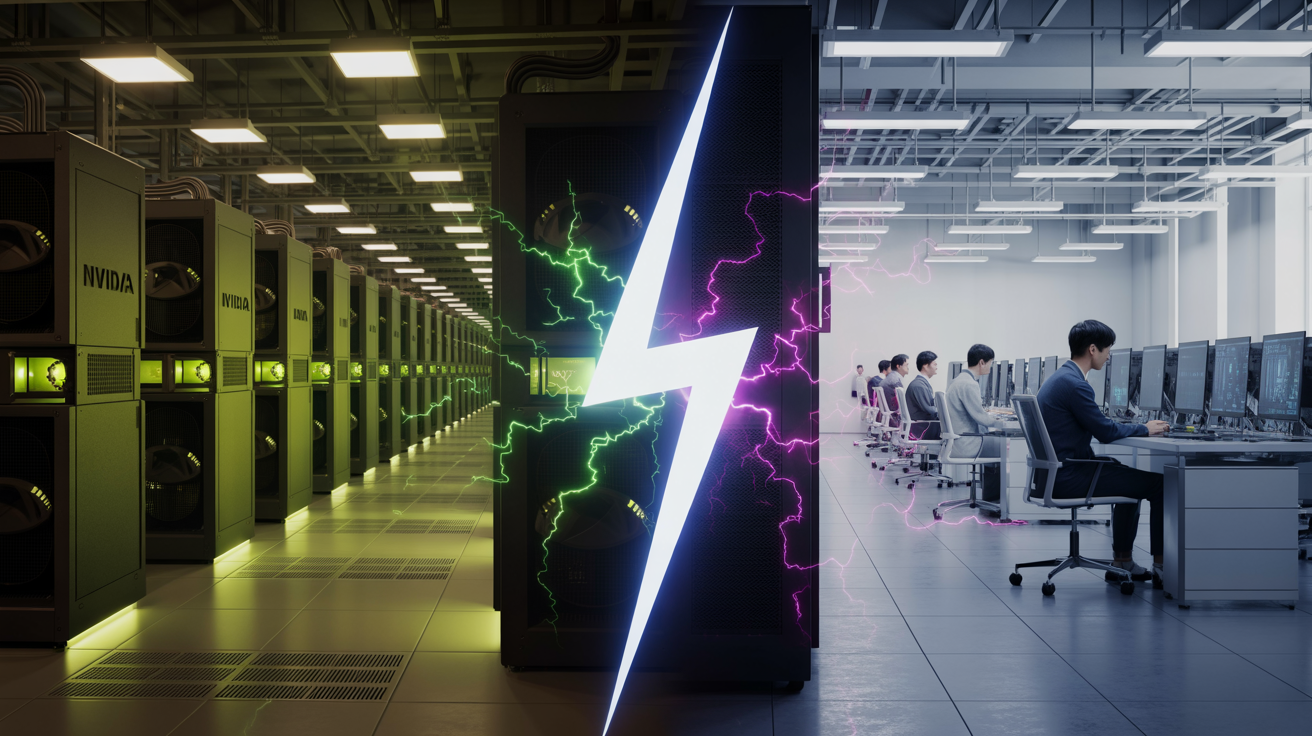
What Wall Street Got Wrong: Analysts assumed AI progress required exponential increases in computing power and capital. DeepSeek proved that algorithmic efficiency—using techniques like Mixture-of-Experts architecture and optimized hardware utilization—could achieve similar results for pennies on the dollar.
The lesson? The AI arms race isn't just about who spends the most. It's about who spends smartest.
The Winners: Not Who You'd Expect
While Nvidia dominated headlines, the real winners of 2025 defied conventional wisdom:

Palantir Technologies (PLTR): +156% YTD
The data analytics specialist emerged as 2025's surprise MVP. While competitors struggled to monetize AI, Palantir's AI Platform delivered tangible results for enterprise clients. Revenue grew 44% year-over-year to $499 million in Q3, with U.S. commercial revenue surging 54%. The company's focus on AI use cases—from military logistics to healthcare data—proved that selling AI solutions beats selling AI hype.
Wall Street's Miss: Analysts dismissed Palantir as "overhyped" entering 2025, with an average price target implying 30% downside. They underestimated the company's decade-long head start in making AI actionable for complex organizations.
SK Hynix (000660): +74.54% YTD
The South Korean memory chipmaker became 2025's dark horse, riding the high-bandwidth memory (HBM) wave. As AI chips demanded faster, more efficient memory, SK Hynix's early investment in HBM3E technology positioned it perfectly. The company captured an estimated 70% of the HBM market, supplying both Nvidia and AMD.
Wall Street's Miss: Memory chips were supposed to be a commoditized, low-margin business. Analysts failed to recognize that AI's computational demands would create a premium memory segment with 300%+ price premiums over standard DRAM.
Micron Technology (MU): +120% YTD
Micron's bet on HBM paid off spectacularly. With AI data centers consuming memory at unprecedented rates, Micron's HBM revenue grew from near-zero to billions in 18 months. Counterpoint Research estimates DRAM prices rose 40% in 2025 driven by AI demand, with HBM commanding even higher premiums.
Broadcom (AVGO): +65% in Q2 Alone
The custom AI chip designer quietly positioned itself as the infrastructure backbone of AI. While Nvidia grabbed headlines, Broadcom designed custom processors for Google, Meta, and Amazon's in-house AI efforts. Q4 revenue hit $14 billion, with AI-related revenue projected to reach $12 billion annually.
Wall Street's Miss: Analysts obsessed over Nvidia's GPU dominance missed the fragmentation play. As hyperscalers invested billions in custom chips to reduce dependence on Nvidia, Broadcom became the invisible hand powering AI's next phase.
The Losers: Bubble Casualties and Strategic Missteps
Not everyone rode the AI wave to riches. Some companies drowned in their own ambitions:

Marvell Technology (MRVL): -33% YTD
The networking chip specialist cratered after reports emerged that it might lose a major custom chip contract—rumored to be Amazon. In AI infrastructure, where relationships and R&D pipelines span years, losing one anchor customer can be catastrophic. Marvell's stock still hasn't recovered.
Adobe (ADBE): -15% YTD
The creative software giant faced an existential paradox: its own AI tools threatened its core user base. As generative AI made video editing, photo manipulation, and graphic design accessible to non-professionals, Adobe's premium pricing model came under pressure. Revenue growth slowed to single digits, and the stock paid the price.
Wall Street's Miss: Analysts assumed Adobe's Creative Cloud moat was impregnable. They underestimated how quickly AI would democratize creative tasks, turning $600/year subscriptions into "nice-to-haves."
Apple (AAPL): -15% YTD
The iPhone maker's struggles stemmed from a different problem: AI irrelevance. While competitors integrated generative AI into every product, Apple's incremental Siri improvements felt dated. Slowing iPhone sales in China and tariff uncertainties compounded the pain. By November, Apple had underperformed the S&P 500 by 30 percentage points.
Meta Platforms: The Great Spending Scare
Meta didn't lose money in 2025—it made plenty. But Mark Zuckerberg's announcement of $370 billion in cumulative AI infrastructure spending through 2026 triggered the stock's biggest single-day drop in three years. Investors suddenly demanded proof that AI investments would generate returns, not just consume capital. Meta's stock recovered after AWS and Alphabet demonstrated AI revenue growth, but the message was clear: the era of blank checks for AI is over.
What Wall Street Got Catastrophically Wrong
1. The "Unlimited Spending" Thesis
Entering 2025, Wall Street believed Big Tech's AI spending would follow a straight line upward forever. Analysts projected $700 billion in data center capex by 2030, with no consideration for ROI.

Reality check: By November 2025, investors were punishing companies whose AI spending didn't show near-term returns. Amazon and Alphabet thrived because their AI investments directly boosted cloud revenue. Microsoft and Meta faced skepticism because their AI spending outpaced demonstrable profit growth.
The Data: MIT research found that 95% of corporate generative AI pilot projects failed to deliver material ROI. When investors digested this stat in October, the Nasdaq dropped 500 points in a week.
2. The China Threat (or Lack Thereof)
Wall Street spent 2024 dismissing Chinese AI companies as "derivative" and "handicapped by U.S. chip export controls." Then DeepSeek arrived.
Not only did the Chinese startup build a competitive model on older chips, it open-sourced everything, allowing developers worldwide to fine-tune its technology for free. Within weeks, Chinese AI companies had:
- Raised Goldman Sachs' MSCI China target
- Triggered a 15% rally in Chinese tech stocks
- Forced U.S. companies to rethink their "compute moat" strategy
What Changed: Wall Street finally acknowledged that AI innovation isn't confined to Silicon Valley. With Chinese firms flooding the market with low-cost, high-quality models, U.S. companies face margin pressure on inference services—the "selling shovels" business model that was supposed to be bulletproof.
3. The "Enterprise AI Will Be Slow" Narrative
Analysts predicted enterprise AI adoption would mirror cloud adoption: a decade-long, gradual transition. They were wrong by an order of magnitude.
The real numbers:
- 88% of enterprises now use AI in at least one business function, up from 55% in 2023
- 71% regularly use generative AI, compared to 33% in 2023
- 62% are experimenting with or deploying AI agents—autonomous systems that handle multi-step tasks
The Surprise: Enterprise AI didn't wait for perfect infrastructure or regulatory clarity. Companies adopted AI tools at software-as-a-service speed, not enterprise software speed. McKinsey's survey found that 60% of enterprises either already see ROI from AI or expect it within 12 months.
4. The Bubble That Wasn't (Yet)
Throughout 2025, bearish analysts warned of an AI bubble rivaling the dot-com crash. Ray Dalio, Sam Altman, and even the Bank of England raised red flags about stretched valuations and circular financing schemes.
But here's what actually happened: AI stocks corrected sharply in Q1, then recovered to trade near fair value by June. Yes, valuations are elevated—the top 10 S&P 500 stocks trade at premiums comparable to 1999. But unlike the dot-com era, today's AI leaders generate massive cash flows.
The Key Difference: Amazon, Microsoft, Alphabet, and Meta have combined annual revenue exceeding $1.5 trillion and net income over $200 billion. The bubble risk exists, but it's industrial overcapacity (too many data centers, too much GPU inventory), not financial leverage.
Goldman Sachs CEO David Solomon summed it up perfectly: "The opportunity in AI is enormous, but there will be winners and losers, and much of the capital being deployed will not produce adequate returns."
The Investment Portfolio Reality Check
If your 2025 returns lagged the S&P 500's 15% gain, here's the uncomfortable truth: you missed the Magnificent Seven.
These stocks—Alphabet, Amazon, Apple, Meta, Microsoft, Tesla, and Nvidia—now account for 33% of the S&P 500 and over 40% of the Nasdaq. Remove them, and the market's 2025 return drops to single digits.
The Concentration Risk: Bank of America's November Fund Manager Survey found that 45% of respondents considered an AI equity bubble the most significant market risk. Translation: Everyone knows these stocks are expensive, but no one wants to miss the ride.
The 2026 Setup: Three Predictions

1. The Great AI Divergence
2025 proved that AI spending doesn't equal AI success. In 2026, the gap between "companies that spend on AI" and "companies that make money from AI" will widen dramatically.
Investment Implication: Focus on Phase 3 companies monetizing AI (Salesforce, ServiceNow, Datadog) over infrastructure providers facing margin compression.
2. The Inference Economy Explodes
Microsoft reported 5X year-over-year growth to 100 trillion tokens processed. Alphabet hit 480 trillion tokens—a 9X increase. OpenAI's annualized recurring revenue reached $10 billion, nearly doubling in a year.
Training AI models was the 2023-24 story. Inference—running those models billions of times daily—is the 2026 gold rush. Companies enabling efficient inference (Astera Labs, CoreWeave) will outperform.
3. The China Factor Intensifies
DeepSeek was just the opening act. With Chinese firms proving they can compete on quality while undercutting on price, U.S. companies face a uncomfortable choice: lower prices and accept margin compression, or maintain premiums and lose market share.
Wild Card: If China's government subsidizes AI inference for Belt and Road countries, U.S. companies could find themselves priced out of emerging markets entirely.
The Bottom Line for Investors
2025 taught us that AI is real, transformative, and profitable—for some. The market's job in 2026 will be separating companies with sustainable AI advantages from those riding narrative momentum.
Here's the scorecard Wall Street missed:
- Infrastructure oversupply is becoming real. Not every data center will fill.
- Algorithmic efficiency matters more than raw compute power.
- Enterprise adoption is accelerating faster than anyone predicted.
- Returns vary wildly: top AI performers generate $10.30 per dollar invested, while 95% of pilots fail.
The AI revolution is happening. But like every technological revolution before it, there will be far more losers than winners.
The question for 2026: Are you invested in the right ones?
Taggart Buie is a financial analyst specializing in AI and technology markets. His analysis focuses on the intersection of market dynamics, technological innovation, and investment strategy.
Sources & References
- 1. Morningstar. "Amid High Volatility, These Are the AI Stock Winners and Losers." November 2025.
- 2. CNBC. "OpenAI CEO Sam Altman Warns AI Market Is in a Bubble." August 2025.
- 3. Invesco. "AI After DeepSeek: Market Implications and Investment Strategies." February 2025.
- 4. McKinsey & Company. "The State of AI in 2025: Global Survey Results." October 2025.
- 5. Bain & Company. "DeepSeek: A Game Changer in AI Efficiency." February 2025.
- 6. JPMorgan Chase. "Global Data Center and AI Infrastructure Outlook." October 2025.
- 7. Goldman Sachs Research. "AI's Opportunity: Winners, Losers, and Return Dynamics." October 2025.
- 8. PwC. "Midyear Update: 2025 AI Predictions." June 2025.
- 9. MIT Sloan Management Review. "The 95% AI Project Failure Rate: What Enterprises Are Missing." September 2025.
- 10. Bank of America Global Research. "Fund Manager Survey: AI Bubble Concerns." November 2025.
Disclaimer: This analysis is for informational purposes only and does not constitute investment advice. Markets and competitive dynamics can change rapidly in the technology sector. Taggart is not a licensed financial advisor and does not claim to provide professional financial guidance. Readers should conduct their own research and consult with qualified financial professionals before making investment decisions.

Taggart Buie
Writer, Analyst, and Researcher